Category: Uncategorized

Working Families Need Flexibility, Not False Choices

We at 1,000 Days are very concerned about the Working Families Flexibility Act which is currently moving through Congress. This piece of legislation would have a significant impact on hourly workers – who are overwhelmingly low-income women, including millions of mothers with young children. While the bill sounds great in name, it misses the mark entirely in substance.

Instead of providing workers with the flexibility to spend time with their families – such as for the birth of a child – this bill would force people to choose between time-and-a-half overtime pay and paid time off – or “comp time” – when they work more than 40 hours in a week. This doesn’t give families the flexibility they need. Rather, it presents America’s hard-working families with a false choice between time and pay, when what they really need is both.

There are several problems with this proposal:

    1. Workers only earn comp time to spend with their families after spending more time away from them by working overtime.
    2. The bill does not guarantee that workers could use the time they earned (and banked) when they need it, such as for the birth of a child or a medical emergency. Employers would have the right to deny employees’ requests to use their comp time.
    3. The bill does nothing to address the need for all working Americans – not just hourly workers – to have guaranteed access to paid family and medical leave.

Working families do need flexibility, but this is not it. America’s workers should be paid for the time that they work – including overtime – AND have access to paid time off for personal and family needs. People should not have to work more than 40 hours in a week and forgo pay to earn the time they need to care for themselves and their loved ones.

Rather than putting forth piecemeal approaches that do more harm than good, Congress should focus on policies that improve the health and economic security of our nation’s families.

That’s why 1,000 Days is calling for a comprehensive paid family and medical leave policy – like the FAMILY Act – that helps ALL working parents in the U.S. give their children the strongest start to life.

Why Support for Breastfeeding Moms Matters

The evidence is clear – breastfeeding saves lives. It protects babies from life-threatening infections and illnesses as well as conditions such as Sudden Infant Death Syndrome (SIDS)—one of the leading causes of infant deaths in the U.S.

Yet recent stories in the news and articles spreading through social media are telling a much different story—that breastfeeding is potentially dangerous and that the “pressure to breastfeed” is leading to babies getting sick or even, in some cases, dying. This is false and misleading.

The truth is that many of these tragic deaths are sadly caused by the lack of support moms receive in this country to breastfeed and properly care for their children. Simply put, we are failing our nation’s babies because we are failing our nation’s mothers.

In this post-truth world, it is more important than ever to set the record straight with facts and evidence.

That’s why I just published a new piece on Huffington Post on the tragic consequences of our nation’s lack of support and what we can do to help moms properly, confidently and successfully breastfeed their babies.

In our society, many moms have to balance their desire to breastfeed with a lack of support and resources to do so. Unfairly, breastfeeding moms are expected to be their baby’s sole source of nutrition while also working, running their household, and somehow finding time for rest and selfcare — all with little to no societal support.

1,000 Days will continue its work to ensure the facts about breastfeeding win-out over misinformation.

Guest Post – Setting the Record Straight on Breastfeeding

Losing a child is a tragedy. As the Internet buzzed recently with the story of Jillian Johnson and the death of her son Landon, our hearts ached. Every mother, every human, feels her pain. Often, the best you can glean from any tragedy are important lessons learned. While it may seem easiest to blame breastfeeding or the Baby Friendly Hospital Initiative, as the click-generating headlines and story promoters simplistically suggest, that would not give the issue proper justice. If the true end goal is to ensure that no mother has a similar experience to what the Johnson family endured, then it is important to consider all the factors that contributed to that tragic loss and how we respond to that loss. We owe baby Landon that much.

Most importantly, we must not allow the media or any organization’s desire to sensationalize a rare occurrence turn into a dangerous, broad-based message that exclusive breastfeeding kills. That is categorically untrue and extremely irresponsible. In fact, decades of global research proves that exclusive breastfeeding consistently saves lives. The World Health Organization reports that over 800,000 babies could be saved worldwide by increasing breastfeeding rates, preventing 13% of all deaths under age five. The Baby Friendly Hospital initiative served over 788,000 births in 2016 alone, providing evidence-based care with positive outcomes. (Note: The Johnson family has not revealed the name of the hospital so it cannot be confirmed that it was indeed a BFHI certified hospital).

Take for example, seat belts. We know seat belts save lives, by and large, yet we also know that people can still die in a car accident while wearing a seat belt. But it would be short sighted to demonize seat belts in general for the specific incidences where unique circumstances meant a seat belt failed to prevent death. We would not condemn all seat belt use, attack seat belt users or criticize all public health campaigns designed to encourage their use, would we?

Yes, Jillian’s story as a rare occurrence must be told. These stories shock us to see the gaps and do better. But we can’t just stand by while sensational headlines and questionable motives trap us into an equally dangerous matrix of fear, divisiveness and emotional manipulation that foolishly paints a broad stroke over an acute complication when decades of scientific evidence proves that breastfeeding—when properly supported—saves countless babies and improves infant and maternal health.

Now for two important acknowledgments: First, we must acknowledge that not all mothers can successfully exclusively breastfeed. While the percent of women who cannot breastfeed due to biological factors is rather small, lactation is impacted by psychological factors such as anxiety and stress and these are mounting in our society leading to increases in incidences of insufficient milk supply.

Second, we have to acknowledge that most physicians simply do not know enough about lactation medicine and we have to start facilitating and demanding that they receive more evidence-based education about a biological norm. Again, we don’t know for sure that Landon was deliv-ered at a certified Baby Friendly Hospital (although that hasn’t stopped the story promoters from blaming BFHI). But perhaps that is more to the point—that all families, regardless of where they deliver deserve physicians and nurses, who are properly trained and certified in lactation science, so they can effectively educate parents to manage breastfeeding, particularly in the early days and weeks after birth. This includes avoiding “one size fits all” breastfeeding advice and being sure to educate parents on the warning signs of a sick infant, beyond counting diapers. That knowledge also includes understanding medical conditions that can impact milk supply including having a C-section, as Jillian did, and certain health conditions such as the hormonal disorder that Jillian had. Physicians need to better understand lactation and lactation failures.

It is also important to note that the Johnson family tragedy happened five years ago. And much has changed in five years. Think of how far we’ve come in cancer treatment, mobile phone technology and even food labeling transparency in the past five years. Meanwhile, contrary to some published reports, BFHI guidelines have always allowed for supplementation when medically justifiable, such as with an infant like Landon who was in distress prior to the emergency C-section. BFHI guidelines also stipulate that a mother’s educated, informed choice for supplementation will not be denied. [See: Baby-Friendly USA. “Guidelines and Evaluation Criteria for Facilities Seeking Baby-Friendly Designation.” Guideline 6.1, p 18-19, Albany, NY: Baby-Friendly USA, 2016]. In other words, no mother who takes in all the facts and still chooses formula will be denied formula. Period. Point blank.

But there is a critical difference between supporting formula use when medically necessary and undermining breastfeeding among all women, all the time, with insidious marketing schemes including back-door, multi-million dollar payments to hospitals for formula marketing rights. The former requires physician knowledge and close monitoring of a specific infant to recommend supplementation as needed. The latter attempts to broadly trip up all mothers before they even start. One requires surgical skill and precision the other just swings a machete. Similarly, using broad-based scare tactics, horror stories and media manipulation to frighten all mothers is equally reckless. The health of mothers and babies is at stake.

However, one of the most painful parts of reading Jillian’s story, for me, is the sense of responsibility that weighed heavy upon her shoulders. Too often in these experiences we hear of mothers who said they read everything, went to classes, etc, only to be let down by the enormity of motherhood and the realities of breastfeeding. This perpetuates the dangerous thinking that it is up to mothers alone to successfully breastfeed or self-diagnose breastfeeding problems. It’s so terribly easy for a patriarchal culture to put all the responsibility on mothers and not chase the real culprits behind why breastfeeding is often so difficult, particularly in the early days. No holding hospital physicians to task for missing early warning signs. No question of how many International Board Certified Lactation Consultants were employed by the hospital to provide sufficient support. No mention of federal and state laws that allow for a 96-hour minimum stay after a C-section birth. No asking about the importance of prompt follow-up home visits (a standard in the UK and most European countries) or where was the social support of other mothers or relatives who could possibly raise alarms. This is what is most dangerous to us all—the isolation of breast-feeding and the burden mothers are told they must bear alone. It is absolutely unacceptable.

But so is fear mongering.

And parading horror stories and graphic images of sick infants to market your agenda.

Which brings me to a very brief word about The Fed is Best Foundation. I’m all in for sharing stories—even at times, tragic ones— they jar us into seeing how we fail mothers so we can ensure it doesn’t happen again. I am opposed to shaming formula feeders. As a first time mom, my baby was given formula in the NICU. And I refuse to subscribe to the breast vs. bottle wars—that’s a concept pushed by marketing propaganda because it drives profits. All mothers simply want the best for their baby. But I’m deeply concerned by the aggressive and mean-spirited com-ments posted by the founders on blogs and social media. People are being viciously attacked or blocked simply for expressing counter opinions and sharing important facts. There’s high school-ish name calling that’s downright nasty (please stand by and watch this comments section) and other tactics clearly designed to silence and control women. Is this the best way forward? Adopting tactics of aggression and using cyber bullying is not the modus operandi of a well-intentioned education campaign that merely seeks to caution mothers. With so much at stake, we owe it to our babies and ourselves to question the true intent here.

Succumbing to scare-tactics without carefully considering the systemic failures and all the facts, including examining those who are peddling it, won’t get any of us anywhere in making true changes to the system that failed the Johnson family. That would simply be yet another tragedy.

Kimberly Seals Allers is an award-winning journalist and nationally recognized infant health advocate. Her fifth book, The Big Letdown—How Medicine, Big Business and Feminism Undermine Breastfeeding was released in January by St. Martin’s Press. Learn more at www.KimberlySealsAllers.com and follow her on Twitter @iamKSealsAllers.


5 Ways WIC Works to Improve Child Health

It is a well-documented reality that children in low-income or food insecure households are generally less healthy than other kids. Early childhood, in particular, is an important time when a healthy diet can make a big difference for a person’s lifelong well-being. That’s why proven-effective programs that reach low-income families with very young kids with healthy foods and nutrition education – such as the Supplemental Nutrition program for Women, Infants and Children (WIC) – are so necessary.

The Center on Budget and Policy Priorities, a research and advocacy organization, recently released a report that outlines just how well WIC works for mothers and children. The paper, WIC Works: Addressing the Nutrition and Health Needs of Low-Income Families for 40 Years, summarizes four decades of research that demonstrates WIC’s effectiveness.

Here are five key ways that WIC is proven to improve child health:

  1. Women who participate in WIC give birth to healthier babies who are more likely to survive infancy.
  2. WIC supports more nutritious diets and better infant feeding practices.
  3. Low-income children participating in WIC are more likely to receive preventive medical care than other low-income children.
  4. Children whose mothers participated in WIC while pregnant scored higher on tests of brain development and later had higher reading scores in school.
  5. The specific set of foods provided by WIC, or the WIC food package, has improved access to fruits, vegetables and whole grains in low-income neighborhoods – for everyone who lives there.

These are life-saving benefits that make a real difference for millions of women and children. WIC effectively improves health at critical points in a child’s development – in utero, during infancy, and during the earliest years. This sets kids on the right course for a lifetime of good health, educational achievement, and prosperity.

WIC Participation Reduces Risk of Adverse Birth Outcomes

Protecting Health Care for Moms and Babies is Non-Negotiable

Over the last several months, we at 1,000 Days watched closely as policymakers sought to repeal and replace the Affordable Care Act (ACA). For young children and their families, high-quality health care coverage is a foundational investment in healthier and more prosperous futures.

Thanks to the ACA, all health insurance plans – including employer-based plans – must provide women and children with health services during pregnancy, childbirth, infancy and beyond. And no woman can be denied coverage or charged higher costs because of pre-existing conditions like breast cancer, pregnancy, C-sections, and diabetes.

But efforts to repeal the ACA puts this all at risk.

As the House Republicans put forth their proposal to repeal and replace the ACA in early March – the American Health Care Act – 1,000 Days and its community mobilized and took action. Thousands of people spoke out and told Congress to protect comprehensive health insurance for women and young children. Dozens of people shared with us their personal stories of why health care matters.

In the end, the leadership of the U.S. House of Representatives called off the vote on the American Health Care Act. This means that, for now, millions of hard-working families with young children will not have to pay more money for lower quality health insurance. A later version of the proposed bill even threatened to remove such basic services as maternity care and pediatric visits.

While the House bill stalled, this looks to be just the beginning.

Even now, on the eve of the congressional recess, rumors are circulating that the House will again try to pass a health care repeal bill. As such, 1,000 Days and its community will remain vigilant.

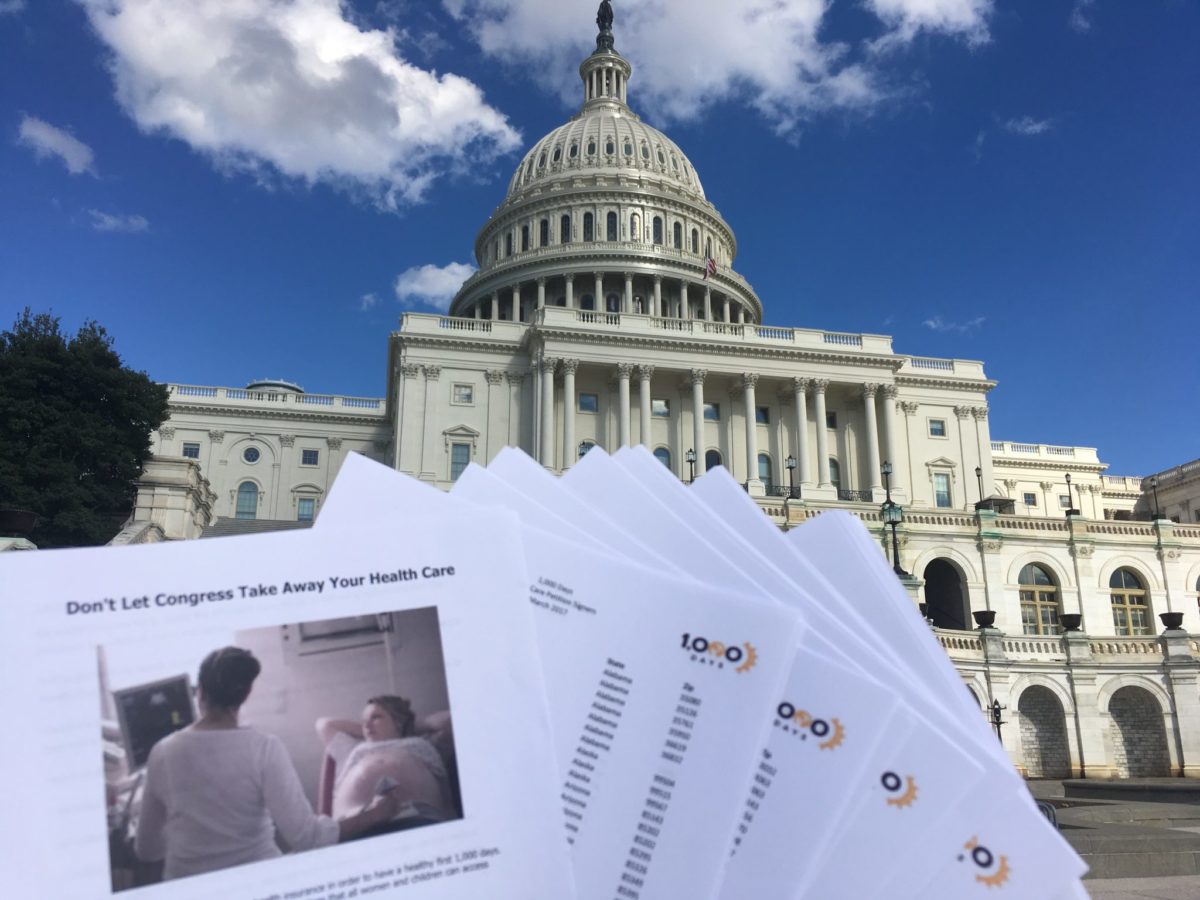
Earlier this week we delivered our community’s petition signatures and personal stories to Members of Congress to let them know that we are watching what they do next.

Ultimately, the health of moms and babies must be a national priority. This means ensuring that women have the health coverage they need to have healthy pregnancies and healthy babies. This is non-negotiable.

Building Off The Momentum of #March4Nutrition

“Our boys are adopted. When we got our first son I asked for maternity leave and was told I could take a couple of days off if I found someone to cover your shifts. I got a 1/2 day off when our second son came and I got zero days when our third son came. I was at work when he was five days old.” – Gabrielle

“I went to WIC in tears when our daughter was two weeks old. We were still having latch issues. The two sweetest women worked with me. Without their support, I truly believe I would have given up. Fifteen months later I am still breastfeeding my little one. I can’t thank them enough.” – Sandra

“My daughter was born three weeks early, developed severe jaundice and was too weak to feed normally. She spent two weeks at the children’s hospital. Insurance covered nearly all of the $90k hospital bill, including meeting with the people who helped get us back to breastfeeding.” – Stacy

These are just a few of the powerful voices that we heard during our online “march” last month in honor of National Nutrition Month.

Over a span of 31 days, more than 60 mothers, fathers and families shared their personal experiences in nourishing their little ones. Many of the stories we received made us smile while others made us cry – but they all shed light on important issues impacting the health of moms and babies in America and around the world.

These issues range from access to high-quality health insurance, comprehensive paid family leave and defending America’s foreign aid investments that cover the cost of proven, life-saving programs.

We’re excited to build off this momentum and continue to stand with the 1,000 Days community on behalf of women and children here in the United States and around the world.

Statement on the Threat to Essential Health Benefits

We at 1,000 Days are profoundly troubled by reports that the leadership of the U.S House of Representatives is working to take away the guaranteed health benefits that are critical to ensuring healthy pregnancies and healthy babies.  As part of the American Health Care Act, (a.k.a.“TrumpCare”), many in the White House and Congress want to take away the “essential health benefit” requirement which covers pregnancy and maternity services, childbirth and newborn and pediatric care, and they are rushing this to a vote at any cost.  This is dangerous and irresponsible.

Without comprehensive coverage for maternity care, childbirth and pediatric services, a woman and her baby are put at greater risk for serious health problems including low birthweight, preterm birth, and even death.  Moreover, when moms and babies don’t have adequate health care, we all pay the price.  Pre-term births alone are estimated to cost the U.S. $26 billion per year in medical and social services costs and lost wages and economic productivity.

Ensuring that women have the health coverage they need to have healthy pregnancies and healthy babies should be a non-negotiable.  Maternity care, childbirth and pediatric services must remain essential health benefits and must be required to be covered by all health insurance plans in the U.S.

We urge Congress to strongly reject the American Health Care Act which will force many hard-working families to pay more money for lower quality insurance and endanger the wellbeing of mothers and young children throughout America.

Proposed Budget Cuts Would Leave Behind The World’s Most Vulnerable, Undermine Our Future

1,000 Days is deeply troubled by the Trump Administration’s proposed budget for Fiscal Year 2018, which, through drastic cuts to lifesaving foreign assistance programs, would hurt the world’s poorest and most vulnerable people.  These cuts come at a time when the world is facing a vast crisis of malnutrition and famine that is taking the lives of young children each day.

The Administration’s proposed 28% cut to the foreign assistance budget is simply not in the national interest of the United States. It will not make Americans any safer or more prosperous and will do little to balance our country’s budget. On the contrary, this shortsighted request will ultimately cost American taxpayers more money, requiring more costly interventions in subsequent years to address the destabilizing effect that malnutrition, poverty, and disease have on communities.

Foreign assistance programs, which constitute less than 1% of the federal budget, have outsized impact around the world. U.S. investments to combat global malnutrition deliver proven interventions that save and improve lives and build trading partners for American businesses. Annual GDP losses attributable to malnutrition average 12% in Africa and Asia, eclipsing the GDP losses experienced after the 2008 global financial crisis. But, for every $1 invested in improving nutrition in the 1,000 day window between pregnancy and age two, we see a return of $48 in better health and economic productivity.

To see sustainable gains in nutrition, we must ensure that a multi-sectoral range of programs is protected and, ultimately, grown. This includes bilateral U.S. development investments as well as our country’s contributions to critical multilateral organizations, such as the United Nations and the World Bank. And, to effectively deliver, we must ensure that the expertise of USAID, the U.S. government’s lead development agency, is strengthened.

We look to Members of Congress to continue their remarkable leadership in promoting international development by securing and protecting the FY 2018 International Affairs budget as an investment in our national security and in our future prosperity.

Statement on the Introduction of the American Health Care Act

1,000 Days has serious concerns about how the American Health Care Act will negatively affect the health and well-being of babies, toddlers and their parents.  As proposed, this bill will force many hard-working families of young children to pay more money for lower quality insurance.

The 1,000 day window between a woman’s pregnancy and her child’s 2nd birthday is a critical window of opportunity to ensure healthy and thriving futures. For this reason, 1,000 Days supports comprehensive coverage for pre-conception and pre-natal care, maternity services, breastfeeding and post-partum supports, pediatric care and other essential maternal, infant and young child health services as well as investments in ensuring families with young children can access Medicaid and the Children’s Health Insurance Program (CHIP) as needed.

The American Health Care Act puts the health of children during their first 1,000 days at risk.  It will make coverage in the health insurance marketplace more expensive and out-of-reach for millions of hard-working families.  Under the American Health Care Act, a woman will pay more out-of-pocket to get the critical health services she needs before, during and after pregnancy that help ensure she has a healthy baby.  And when expectant mothers can’t afford health insurance, we all pay the price.

We are also concerned about the severe cuts to Medicaid and CHIP, which today play a critical role in providing health insurance to low-income Americans. Medicaid and CHIP currently provide coverage for 45% of all children under the age of six and the Medicaid expansion helped more than 10 million adults gain coverage for the first time. The American Health Care Act threatens to cut off millions of young children and their parents from their health insurance and strip away the essential benefits guaranteed in Medicaid, which means that some women will no longer be assured they can get the medical services they need to have a healthy pregnancy and a healthy baby.

All children in America deserve a healthy start to life.  The American Health Care Act makes it harder and more expensive for families to access the health care they need to ensure that their children have the healthiest first 1,000 days and the opportunity to reach their full potential. 1,000 Days urges Congress to vigorously oppose this proposal and instead focus on building a healthcare system that ensures all mothers, babies and toddlers in America have the care they need to thrive.

Couldn’t have done it without ACA

My son Diego surprised us all when he was born in April 2015, seven weeks before his due date.

After an otherwise uneventful pregnancy, during which I was fortunate to receive top rate prenatal care, his pre-term delivery came quickly and unexpectedly, without much warning.

My husband and I weren’t ready for his arrival, simply because we thought we had more time. We didn’t have a car seat, Diego’s crib was still in a box, and my husband and I spent the minutes between contractions searching the internet as we tried to decide on a middle name.

As parents, it was one thing that we were not prepared. But more importantly, Diego wasn’t ready for his own arrival. Born at 33 weeks, weighing just over five pounds, his lungs were not fully matured and he did not understand the basic survival technique of how to eat on his own, a skill developed in the third trimester.

Diego spent 17 days in the neonatal intensive care unit (NICU).

Our family is thankful for the care he received there and the support that we were given as new (and scared) parents.

Although his care was invaluable to us, it did come with a specific price tag: Diego’s two-week hospital stay approached $300,000.

We were lucky that Diego didn’t suffer from any enduring health problems – he was simply born too early. But many infants who spend time in the NICU require more intensive procedures or longer hospital stays.

Their hospital bills can quickly add up to well over a million dollars.

In 2009, before the passage of the Affordable Care Act (ACA), 59 percent of all workers (and their families) covered by employer health plans had a lifetime limit on their health insurance benefits. This means that there was a maximum dollar amount health insurance companies agreed to pay. If you surpassed that amount, then the cost for health services came out of your own pocket.

While those limits varied (and sometimes were as low as $1 million), many infants with NICU stays reached their lifetime limits on health insurance before they even left the hospital.

With the passage of the ACA, lifetime limits were prohibited, alleviating that concern for families of pre-term infants and others facing medical complications.

Because Diego was born before he learned how to eat on his own, he spent the first week of his life being fed through a feeding tube. As I knew the benefits of breast milk, particularly for a pre-term infant, I was intent on breastfeeding Diego.

While some moms who experience pre-term labor have difficulty producing breast milk, I was relieved that my hospital was supportive of my goal to breastfeed, lending me a breast pump to use in the hospital within an hour of delivery.

Outside of the hospital, I was also fortunate to benefit from the ACA provision that requires health insurers to cover the costs of a breast pump for new moms. Without this support, many new moms are unable to purchase effective breast pumps, making it impossible for them to meet their own breastfeeding goals.

When Diego was released from the hospital, he was able to effectively feed from a bottle but we still struggled during our many attempted breastfeeding sessions.

Discouraged, I was thankful to find out from a friend that the ACA also required health insurers to provide access to lactation support services. I credit the supportive and skilled assistance of a local lactation consultant for saving my breastfeeding relationship.

When I returned to work after my paid maternity leave, I was also provided time to pump during the work day – a right protected under the ACA. These key provisions allowed me to meet – and even exceed – my initial breastfeeding goals.

Our family felt lucky to have the support and care that both Diego and I needed during such a vulnerable period in our lives. But it shouldn’t be left to luck.

As the healthcare debate continues in the halls of Congress and beyond, it is critical that the United States maintains health coverage for all, regardless of employment or income, and that that health insurance is affordable and comprehensive, providing the coverage needed for children and their families to thrive.

Any effort to eliminate the protections I benefitted from would have detrimental effects for moms and babies everywhere.

And that is why I added my name to the petition: Don’t Let Congress Take Away Your Healthcare.