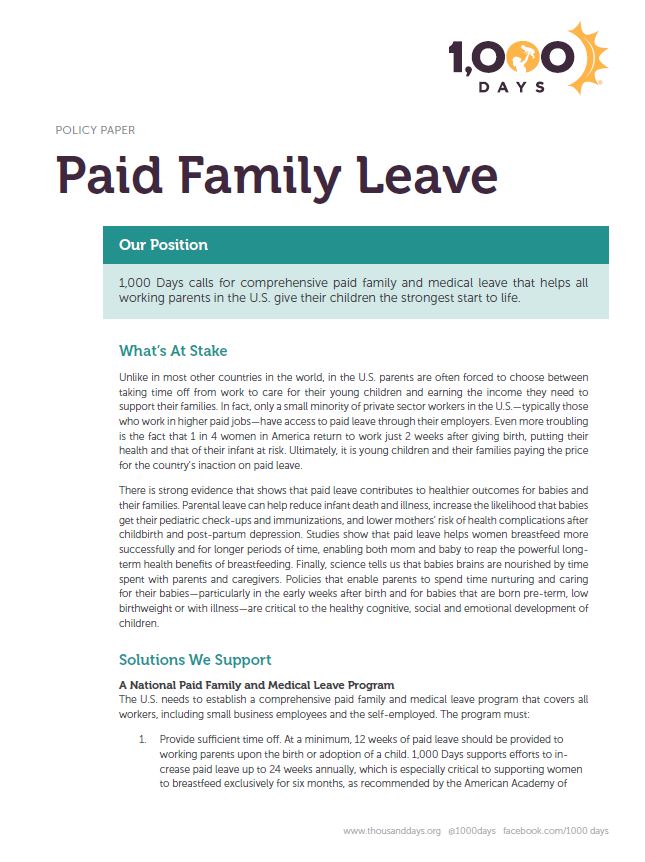
1,000 Days Policy Brief: Paid Leave

1,000 Days believes that all workers deserve paid time off from work to care for their young children. For this reason, 1,000 Days calls for comprehensive paid family and medical leave that helps all working parents in the U.S. give their children the strongest start to life.
1,000 Days Policy Brief: Health Insurance

1,000 Days believes that every child in America deserves a healthy first 1,000 days. For this reason, 1,000 Days supports guaranteed access to high-quality, affordable health insurance that offers comprehensive benefits for pre-conception and pre-natal care, maternity services, breastfeeding and post-partum supports, pediatric care and other critical maternal, infant and young child health services.

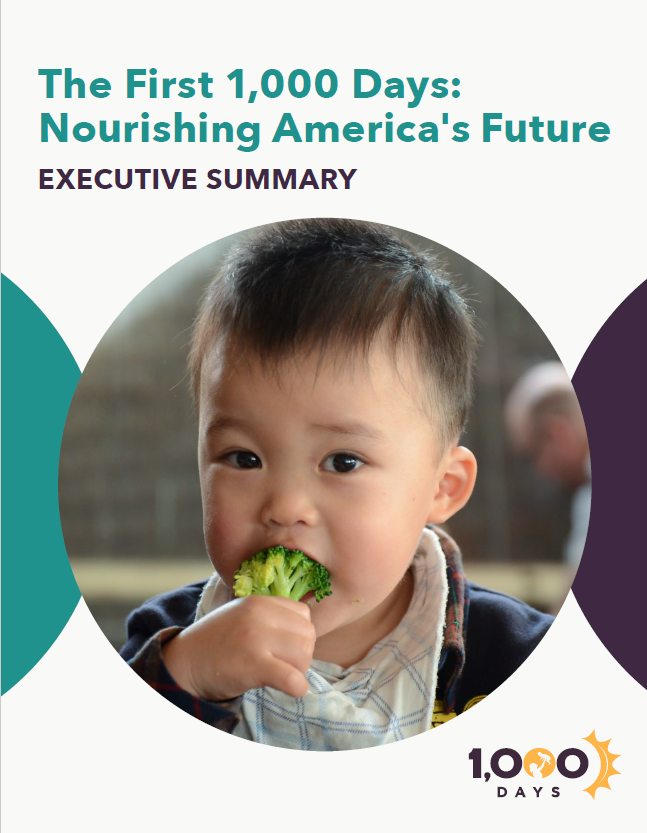
Executive Summary – The First 1,000 Days: Nourishing America’s Future

The problem of poor nutrition is pervasive throughout the U.S. Too many American women and young children suffer from high rates of obesity, food insecurity, unhealthy diets, and low rates of breastfeeding. In order to illuminate the challenge of malnutrition in the United States and galvanize a movement to ensure that every child has a healthy start to life, 1,000 Days – with support from the W.K. Kellogg Foundation and the David and Lucile Packard Foundation – launched a first-of-its-kind report on the nutritional health of America’s mothers, babies and toddlers.

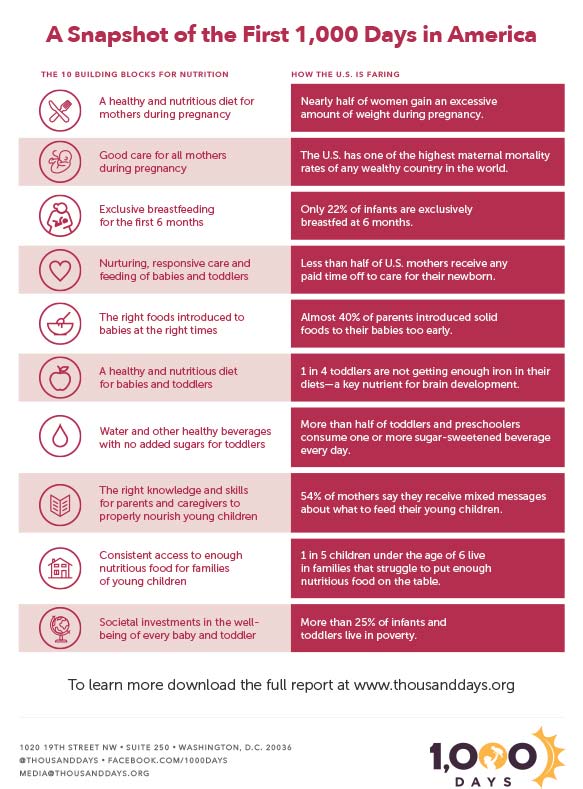
A Snapshot of The First 1,000 Days in America

The problem of poor nutrition has dire consequences for women, infants and children in the U.S. When examining how young children and their families are faring when it comes to nutrition, the statistics paint a troubling picture. As part of its report on the nutritional health of America’s women and young children – The First 1,000 Days: Nourishing America’s Future – 1,000 Days provides a snapshot of the first 1,000 days in America.

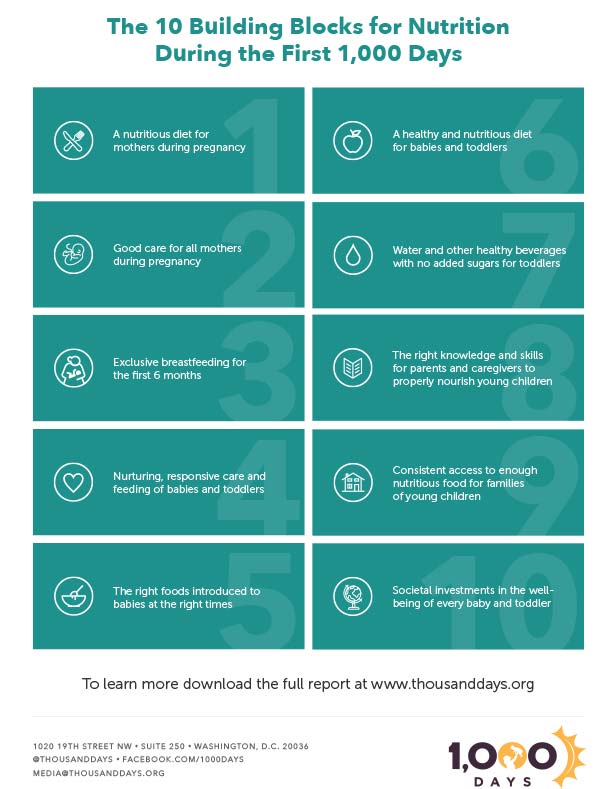
The 10 Building Blocks of Nutrition

The science is clear about what children need during the first 1,000 days in order to grow, learn and thrive. Based on a literature review of existing scientific evidence, along with recommendations from the World Health Organization (WHO), the American Academy of Pediatrics (AAP) and other leading experts, 1,000 Days identified a set of 10 “building blocks” for good nutrition in the first 1,000 days. These building blocks represent what every child needs to have the strongest start to life and all 10 of them are essential to healthy growth and development.

The First 1,000 Days: Nourishing America’s Future

The problem of poor nutrition is pervasive throughout the U.S. Too many American women and young children suffer from high rates of obesity, food insecurity, unhealthy diets, and low rates of breastfeeding. In order to illuminate the challenge of malnutrition in the United States and galvanize a movement to ensure that every child has a healthy start to life, 1,000 Days – with support from the W.K. Kellogg Foundation and the David and Lucile Packard Foundation – launched a first-of-its-kind report on the nutritional health of America’s mothers, babies and toddlers.

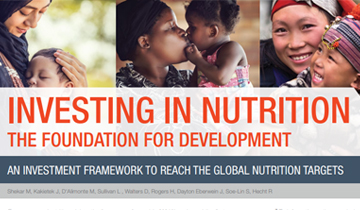
Investing in Nutrition: The Foundation for Development

Malnutrition kills millions of children every year and robs millions more of the opportunity to reach their full potential. This global crisis requires global action in order to give every child a fair start to life.

In 2012, world leaders committed to reaching six global nutrition targets by 2025. Yet, reaching these targets in the next decade will require significant investment. World leaders must act now to fulfill their promises and save millions of lives.

The World Bank, Results for Development Institute, and 1,000 Days – with support from the Bill & Melinda Gates Foundation and the Children’s Investment Fund Foundation – conducted an in-depth analysis of how much it will cost to meet four of the six global nutrition targets, and how to pay for it. Download the report to learn more.

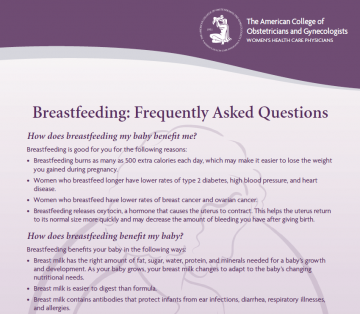
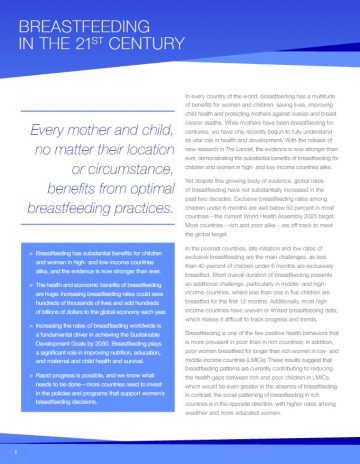
The Lancet Breastfeeding Series

Released January 2016, The Lancet Breastfeeding Series highlights the significant economic and health benefits for both rich and poor countries alike when governments support breastfeeding through meaningful investments and programs.  Based on a growing body of evidence, the Series finds the global costs of lower cognitive ability associated with not breastfeeding amount to more than $300 billion each year, a figure comparable to the entire global pharmaceutical market. Moreover, 820,000 children’s lives could be saved annually with increased breastfeeding rates, a nearly 13 percent reduction in all under-5 child deaths.